
Recommend: No
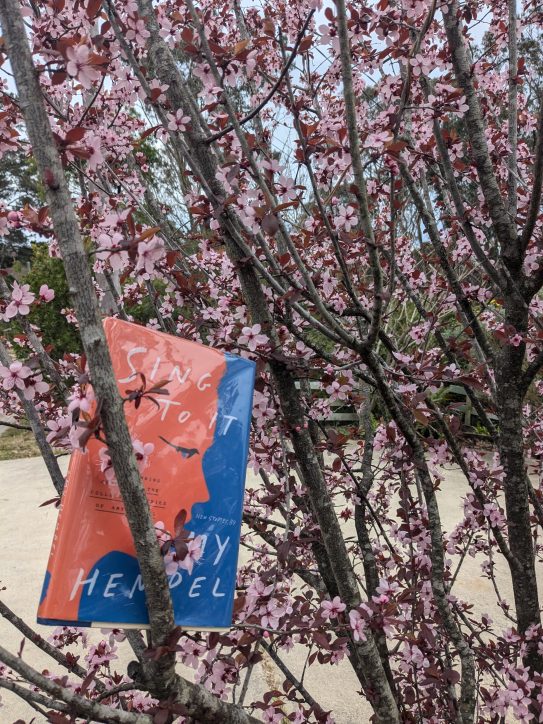
Bonus week is upon me at the bank. It’s an annual scramble where each employee must parade their relevance, which is largely a well-tended, year-long sham built on politics and connections. The stories in Amy Hempel’s short story collection, Sing To It, emit the same desperation to be noticed.
There are many tiny stories that proceed one large story, making it a collection of two parts, both uneven.
The stories, which can be as small as a page, drop you somewhere unfamiliar and you must struggle to find out why here and why now. Necessary in this conceit is the need for each story to convince you it is worthy in a very small stretch of time. Look, I am the quirky one; I am the fastidious one; I am the conscientious one; I am; I am; I am… The effect is jarring and, honestly, a bit soulless. It’s how managers must feel as they process intern bonuses. Many small fries in a packet, some colder than others, some saltier than others, all attracting the same price. Eaten up by a thankless mouth. And that’s how I felt going through the small stories, munching indiscriminately through the platter, trying to ascribe preference but it’s all largely a trick of the mind. At their core, the stories impart little individualism, and meld into a stodgy thickness.
The larger final story, Cloudland, is a muddied 70 page journey that I’d rather not have taken, and it felt so much longer than it actually was after the whipcrack quickness of the first section. It suffers from the structural whimsy of Jenny Offill’s Dept. of Speculation. Ellipses segment different parallel aspects of the narrator’s life. The ghost of a child given up for adoption in an earlier life leaks into a prying neighbour’s want for control and gossip, which veers into regret for taking cocaine with her students. The threads do not come together effectively and end up detracting from each other. I love this character description we get of a client, which is really very insightful, but then the character is inconsequential, so it ends up being a nice paragraph and nothing more.
This man in his nineties was once a CEO of a large north-eastern corporation. I think we hit it off because he told me he had often wished, before heading into a board meeting, that he was a desk clerk in a modest chain motel.
Look, Hempel had a raw deal here. I read her directly after John Steinbeck’s remarkable short story collection The Vigilante. Steinbeck’s imagery was so potent and distinct that each of his three stories sits very clearly in my memory. They were economical stories well fleshed out in themselves (the plots) but also with a depth that stretches out long past the page (the residual mood). Hempel’s typically have no plot and you have to guess at what feeling she is aiming for.
Mirada July attests that “Hempel is the writer that makes me feel most affiliated with other humans; we are all living this way – hiding, alone, obsessed – and that’s okay”. Hempel’s prose does remind me of July’s, albeit a July who hadn’t had sex in a few years. It is self-satisfied with its quirkiness, often with little substance behind it. But there are two stories that escape this fate.
Narrated by a wife who stalks her husband’s infidelities and plans to (violently) sabotage his affair, Greed is mostly coherent. There are intriguing turns of phrase (“She was many years older than my husband, running on the fumes of her beauty.”) and allusions to a deeper plot (“She was not the first. She was the first he would not give up.”). There’s a self-aware July-esque humour that is effective because it adds to the story, instead of being the purpose of the story:
“I said to myself, “I am a better person!” I am a speech therapist who works with children. Parents say I change their lives. But men don’t care about a better person. You can’t photograph virtue.”
The other story that feels different is The Second Seating. It uses brevity to its advantage, capturing a small moment after a large life, and delicately extends the narrative far beyond the photolike scene of a group of friends having an expensive dinner out.
And it’s The Second Seating I would present at bonus day as evidence of my success: on a day-to-day basis, I’ve left no impression of greatness, but here is proof that, at my best, I can compete.
The Second Seating – Amy Hempel
The three of us were taken with the vodka fizz made with elderflower and basil so we stayed on and had the raw kale salad and heirloom tomatoes with medallions of halloumi. These were such that we ordered the scallops, and then the frozen chocolate crème brulee. We had had to arrive early and flag a table outside to get to order anything at all, so by the time we had finished our dinner, the sun was still showing through the trees near the bay. The day before had been rain all day, so we were satisfied to stay in our seats and take in the scents from the well-tended garden surrounding the lodge.
Bob, dying, had made us promise we would have dinner there without him in the same way he’d told his wife to go ahead with plans to add a screened porch to their house – so there would be one room not filled with memories of him.
We had already missed the last ferry to the mainland. We had nowhere else to be. A couple approached our waitress for a table. She told them the second seating had already filled. We could have given up our seats and paid our bill. But we said to the waitress that we wanted to start over. Then we ordered more drinks, and later the cod.

Leave a Reply