
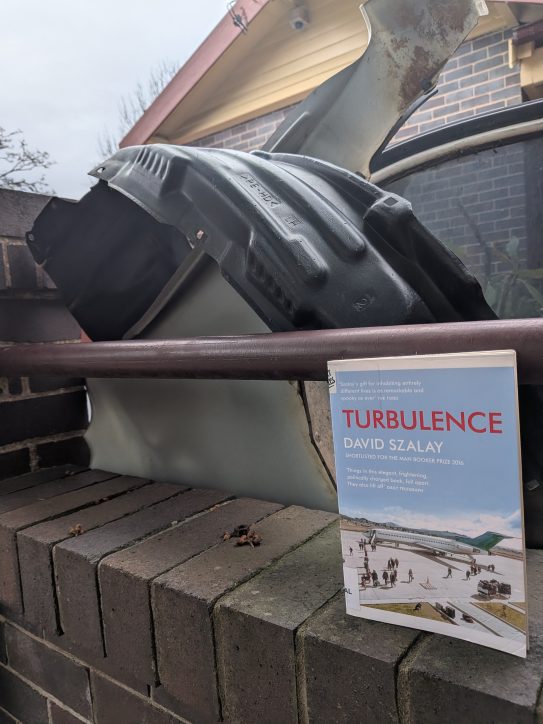
Recommend: No
Every time the plane shifts from an engine whirl to a new, different, louder, more unstable engine roar, I sweat. Each ‘ding’ from the overhead cabin causes anxiety to shoot up through me. Is the seatbelt sign on? Do the cabin crew look nervous? The man next to me didn’t put his phone on flight mode. Should I tell someone?
Always the same reassurance back: this plane is safer than a car, relax, stop driving your fingernails into my hand, I’m starting to bleed.
In an airliner inspired show of risk aversion, Turbulence is a book of short stories that plays it safe.
Each chapter finds its main character either on or fresh off an airplane. The reason for the journey is to see family, or to return home from seeing family. For each of them, the airport represents a change in state – one life on pause to resume another upon arrival in a different country. While we are with that character, Szalay will slyly introduce us to another character, and it will be this new person that we will follow in the subsequent chapter. Characters never repeat after that. Their individual stories span only two chapters: firstly as the subject of interest and then reduced to an echo in a following chapter, and then they disappear. The resulting impression Szalay leaves is that the individual is temporary and therefore without lasting meaning. The only constant, he suggests, is humanity’s movement around the globe and through time.
The pretext of setting up the next character’s story within the current chapter is smart, yet lazy. It fuels the reader’s belief that each chapter is building upon the last. It manufacturers the expectation that the book will culminate in a greater truth. This is a pretense only. The sum of the parts does not make a more cohesive whole in Turbulence.
Szalay himself is never emotionally invested in his characters. He knows they will be quickly discarded. To him, characters are merely one segment of life that blurs easily into the next, with no climax outside the satisfaction of accumulating chapter counts. Szalay tries to make up for this lack of tension by featuring characters at heightened moments of their lives. But no sequence of dire cancer diagnoses, house fires and homosexual affairs alone can rouse a reader. We can get all the above from an episode of Euphoria and watch Sydney Sweeny naked. More nuance is demanded of an author to protect a book of short stories from feeling formulaic.
Turbulence was competent enough but with no challenge or verve. The seatbelt sign was off the whole time, smooth navigation through cruising altitude. All systems nominal. It was sort of comforting, in the way that an uneventful short plane ride is comforting. Time has progressed without incident. So little has been demanded of you that it barely registers as an event in your day. I read most of Turbulence at a hotel breakfast hall with screaming kids running around and pop music blasting far too loud for 8am. It worked to carry me through that cold Canberra morning and that’s where I’ll leave it.
I am interested to see what Szalay does with the space afforded by, and the commitment required of, a full novel. Particularly because the Booker Prize judges thought he did just fine.


Leave a Reply