
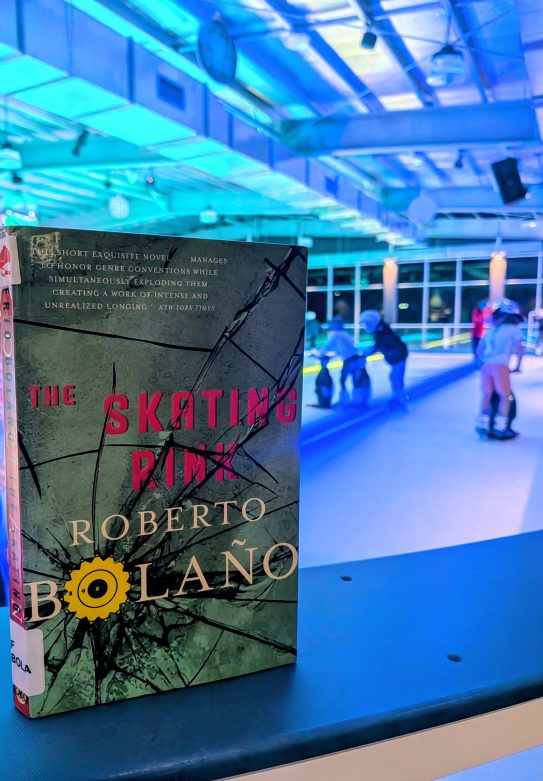
Recommend: Yes
The Skating Rink by Roberto Bolano is not a perfect book. It’s not even a perfect piece of (crime) genre fiction. Yet it’s nearly always engaging, faltering only in the last ten pages. On an individual sentence level it is not as flawless as Rachel Cusk’s Parade but there are still many striking turns of phrase that build a character, or their social context, succinctly.
Let’s be clear, these characters are all losers of varying pillars of the small Spanish coastal town a few hours from Barcelona.
The action all revolves around a fat, unloved, rather self-righteous politician who has fallen in love with a professional figure skater. The girl is a bit down on her luck. She’s been kicked out of a national team, not necessarily due to lack of skill but more likely because someone higher up prefers a different girl just a little more. Stripped of her funding the figure skater must leave Barcelona and return to Z, the unnamed town of the novel, where there’s nary an ice-skating rink to be found. How will the figure skater retain her relevance in the sport and ensure she is trained and ready to go when she next gets on the right side of the grant money? Enter the politician who, for the small cost of one’s morals, steals the skaters attention by building her a private rink, tucked away in an abandoned beach-fronted estate, from the public coffers.
As the skater twirls and pirouettes, the novel switches between two other perspectives. The second narrator is a local entrepreneur who owns, among other unglamorous businesses, a caravan park. And thirdly a dropkick who had befriended the caravan park owner in their uni days and now is employed seasonally at the park. The novel bounces across these three narrators.
All three narrators are loosely linked together in this small town of Z and their initially brief interactions escalate when drama befalls the skating rink. Bolano refuses to indent even a single paragraph so each chapter inevitably becomes a frantic stream of consciousness spilling out of its narrator. You do get used to the pacing. In every section you are always a little distrustful of the proceeding narrator’s rant and are eager to this time get a clearer picture of what has happened.
Bolano was a poet by passion and only turned to fiction to earn money for his family. The Skating Rink was his first novel. As might be expected with a debut, there are some clear problems with structure. Most relationships seem to develop more by chance than connection. As a result, key tensions in the plot are undermined and handwaved away. Also, little asides from one character assessing another are tantalising but not fleshed out ever again. For example, the politician refers to the camp ground owner disdainfully, calling him a drug dealer. This is an interesting and new revelation. But then nothing happens with the assertion. If the character is indeed a drug dealer apparently it is irrelevant to the story.
So yes, it would be easy to compile a list of things Bolano did wrong with this novel. That didn’t stop me looking forward to opening it back up each time. I was totally caught up with the smallness of the lives of these three men, all circling around a doomed ice skating rink.


Leave a Reply