
Recommend: No
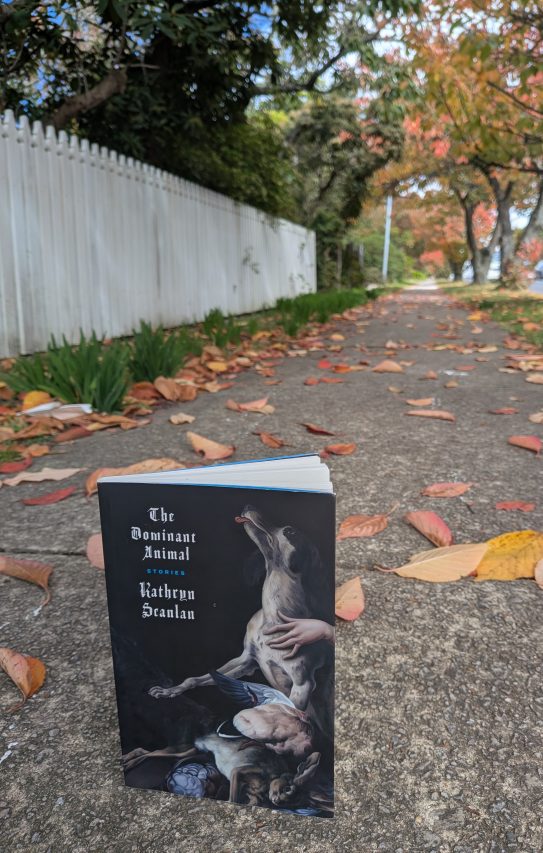
The Dominant Animal by Kathryn Scanalan is another frustrating book of short stories. The timing was awkward. I had picked it up only minutes after airing my disappointments with A Sunny Place For Shady People.
The Dominant Animal also leans into gothic tropes, although Scanlan’s use of the genre is quieter than Enriquez’s. You will not find physically grotesque and/or incomprehensible forms in Scanlan’s stories. Nor will you be faced with evil demons or have to placate lascivious spirits. Instead of resurrecting the literal apparitions of gothic fiction from the grave, Scanlan twines together the genre’s penchant for ambiguity with the carefully chosen realism of modern literary fiction to produce an atmosphere of chilling disquiet.
Scanlan is an author of unease.
These are tiny stories – flash fiction, if you will. There are twenty stories in just over a hundred pages, the smallest being only a paragraph long. Most fill only two pages, and that includes generous white space allowances for the titles of the stories. None of these are explicitly gothic in plot, although every single one of teeters right on the edge, precariously balanced over some evil abyss.
Take, for example, the story Ta-Da. The narrator walks down a suburban street. What should be a stroll of no consequence, one of hundreds in a year, is plagued with violent imagery. The narrator can hear a drunk behind a fence “attempting to express the disappointment of his life”. Next the narrator passes a man gardening, his saw “cutting the wet orange flesh of the tree”. The story slows in the middle. The change in pacing is actually quite impressive given the story barely covers a page length in total. We are lulled into the contentment of a quiet, domestic evening stroll. It could have been any late Sunday blockie around Blackheath as the sun sets.
On my way back down the street, the dusk was darkening the houses and shrubs from the ground up, like dye climbing a cloth. This was the shaded side of the hill and on a bright day would be ten degrees cooler than the sunny side.
But the peacefulness does not last.
Below me, in a year that sloped steeply into a deep gulch, I heard the pronounced rustle of disturbed underbrush, and I saw that a large shrub was shaking dramatically. I was reminded of an old dream I have from time to time, wherein a German Shepherd tears off an arm of mine. Then I thought of the old tale of some bush that had once shuddered with the spirit of the Lord – or had it burned?
Slowly, from the shrub’s thick, dark leaves, a bare arm emerged. Then a denim clad leg struggled forth, attached to a foot housed in a white athletic shoe. It was clear by now that a difficult birth was under way.
I’ve always been a sucker for origin stories, so I held my breath and waited to see how this one might begin.
End story.
There are so many brutal verbs and adverbs in such a small story, set in the backwaters of any town: disturbed, dramatically, tear, shuddered, burned, struggled, birth. From this archetypical story you can see how Scanlan uses the language of the gothic to imply a darkness not far below the surface of the normal. The unknowable lurks only ankle-deep under the ocean of the recognisable.
The problem is, despite patches of very competent writing, it’s mostly atmosphere to no end. Consider the ending of that story above, Ta-Da. My attention is sparked only for the fuse box to blow abruptly and for the story to end. Was the man emerging from the bushes taking a shit on his run? Did he get lost and was pushing his way through the thicket back to the street? I am also a sucker for an origin story but am left waiting forever for it to come forth.
It’s okay to have some stories like this. But to have twenty consecutively is too much ambiguity, too much whiplash flicking from one un-resolution to another.
As with all short story collections, some of the stories shine brighter than others. One I did very much enjoy was Shh.
Shh
The story Shh probes the arbitrariness of our sympathies towards animals. The narrator is undertaking surgery and, to distract the mind, muses on the integrity of the surgeon’s character. The surgeon behaves as many rich people do, with a self-righteousness that is unchallenged by society. One of his causes is animal welfare.
My surgeon gave considerable sums – enough, by the sound of it, to support severable sizeable families – to animal rights groups. His wife was very particular about their leather. She rescued wrecked racehorses – doomed for glue – to keep as pets.
But when a gang of mice infest his garage and threaten to degrade his expensive cars, his morals lapse.
The exterminator recommended glue traps. I didn’t think it through, my surgeon said. He shook his head sadly. The next morning he found them – cruelly stuck, alive and crying.
What did you do? I said. I was flat on my back below him, gowned and shaved.
Well, he said, I got my bag. I got my scalpel. I thought I could slice them off of there. They’d have clumps of glue on their feet, but they’d be free, he said.
Did it work? I said. Did you save them? A nurse fitted a mask on my face. Somone turned on the gas.
Well , no, he said. The first one I tried, I sliced off its foot instead. There was a lot of blood, actually. I was terrible, he said.
I opened my mouth, but only a little squeak came out.
Shh, said the surgeon. Over my face, his gloved hand hung – you could even say it twitched. Then, with his fingertips, he pushed the lids of my eyes shut. You’ve seen this before – some man, overcome with shame, unable, for selfish reasons, to look at what he’s done.
I thought this was a marvellous piece of ‘flash fiction’. Firstly, the way this story of the mice infestation is recounted is very smart. The surgeon is hovering over someone lying on a hospital bed. As they are about to go under for what must be a serious, daunting procedure, the surgeon polemises not about the terrifying future of the patient but about firstly his wife’s respect for animals and then secondly the mundanities of their conflict with his personal hobbies. In this way, the surgeon’s character is cleverly rendered. He is just a self-centred man who is the boss of the animals in his life – both the mice in his garage and then humans who come into his practice. There’s little empathy emanating from the surgeon, just a useless shame.
And then there’s the brilliant parallel of the story of the mice and the story of the patient. Both are at the behest of this man, the surgeon. Both do not trust the motives behind his scalpel but they cannot escape it. The helplessness of mice before men is likened to that of patients before their surgeons.
Shh is in the minority though. Only it and a few others had such a strong, self-contained narrative. The rest had segments of poorly fleshed out plot floating around, looking for a home so that they could eventually, one day, grow into something coherent.
The Dominant Animal
The collection is not named The Dominant Animal on a whim. Every one of these twenty stories somehow speaks to the way humans live with animals. This theme can be hidden, as it was in Ta-Da, with the narrator referencing, as a throwaway line, a nightmare they have repeatedly of a German Shepherd attacking them. Or it can be very obvious, as it was with the mice in Shh.
This sounded interesting from the blurb, and if there were fewer but longer stories, it could have been an engaging premise. With twenty stories though it felt like the thematic consistency was forced, and therefore it lost impact and purpose.
Again, I end a review of short stories disappointed. There was good writing, and I wanted to like it, but it would have been better to a read a (more judiciously chosen) subset of these stories here and there literary journals over the year.
Quantity did not ensure quality, and I lost patience and enthusiasm.


Leave a Reply