
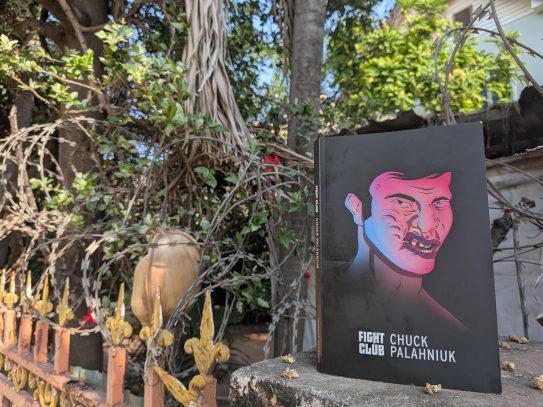
Recommend: No
I watched Fight Club in the same week as Pulp Fiction. Before this I’d always thought about the two movies interchangeably. Both were released in the 90s. Both had sharp two word titles with verbs that evoke anti-social violence (‘pulp’, ‘fight’). Both movie posters had the same style – actors leering at you, seductively aggressive, daring you to watch the spoils of their film.
One difference: Fight Club is based on a book.
Another difference: Pulp Fiction was ground breaking.
It’s not that the Fight Club movie was bad. It was slick and entertaining and, yes, transgressive. But I thought it lacked the spark that would have taken it from good to great. It worked so hard on being cool that it forgot the audience of regular humans. For example, Helena Bonham Carter’s whacky chaos was not substantial enough ground on which to build the heart of the film. Characters are thrown from one unreality to another with force but little empathy. We are stimulated in their stimulation, though not emotionally invested in their emotion.
All this to say I found the limitations in the original text.
Fight Club the book is really good. It’s an excellent idea for a plot. Exhausted by the pressures of modern capitalism, and finding their material rewards unsatisfactory, the narrator is entranced by the misanthropic Tyler Durden.
Tyler Durden appears out of nowhere on the narrator’s beach side holiday like a messiah. Tyler Durden is rubbish-tip-chic. He’s friendless but friendly. He’s the ‘everyman’ on a mission not to elevate himself but to bring down those on top. If you’re at a five star hotel, I wouldn’t drink the expresso martini he serves you.
Joining forces with the narrator, the two liberate themselves from commerical and societal responsibility by getting beaten to a pulp. The logic: who cares what type sofa you own when you can barely breathe through broken ribs. Reducing life down to life or death makes each moment of life a relief rather than something to be endured.
The plot of the novel explores what happens when this idea of violence as a personal ‘cleansing’ is taken to more extreme ends. Palahniuk takes us all the way through to total anarchy. The question that gains urgency: who is this man, Tyler Durden?
It’s a compelling story.
There’s some vivid writing about the way capitalism forces us to dull our time and the relief when we are allowed to break away from that.
Walter from Microsoft catches my eye. Here’s a young guy with perfect teeth and clear skin and the kind of job you bother to write the alumni magazine about getting. You know he was too young to fight in any wars, and if his parents weren’t divorced, his father was never home, and here he’s looking at me with half my face clean shaved and half a leering bruise hidden in the dark. Blood shining on my lips. And maybe Walter’s thinking about a meatless, pain-free potluck he went to last weekend or the ozone or the Earth’s desperate need to stop cruel product testing on animals, but probably he’s not.
Palahniuk just doesn’t quite land it.
The love interest, Marla Singer, is a poorly drawn, annoyingly quirky character who features a lot in the plot but moves nothing along. The main twist is rushed when revealed and from that point on the novel struggles to hold its tension.
There are also confusions in the novels anachronistic message. The narrator chooses to get beaten black and blue as a release from the monotony of his job in compliance at a car company. Why doesn’t he practise what he preaches and do something different with his life? He nearly shoots a guy for not pursuing his dream of being a veterinarian, yet the narrator keeps going back to work and a few times admits he actually kind of likes his boss. Are we all meant to quit our shitty jobs and… do what? Or are we all meant to keep at it but to take ourselves down a notch in our private life to keep perspective… to what end? It’s like Palahniuk can’t identify what he wants and equally can’t define what he hates and the novel is weaker for the ambivalence.
It’s not a ground breaking novel but it is enjoyable pulp fiction.


Leave a Reply