
Recommend: No
Sport connects people when they can’t do it by themselves.
I have seen this play out at work countless times. Two people, who can’t even relate to each other when they have the same job, are able to engage easily with each other over a shared interest in a particular sport.
Currently I overhear the following daily interaction that I presume will endure for the full length of the Australian Open and perhaps even beyond that, such is its timeless quality.
Team Member 1 [Senior]: Wow, how about that tennis?
Team Member 2 [Junior, does all the actual work of TM1]: Yeah, tennis.
Team Member 1 grins inanely.
Team Member 2 reverts gaze back at screen to complete the work widely assumed to be done by TM1.
As someone completely uninterested in competitive sport I often wish ill upon these conversations: how dare these people speak so freely to each other. Where is all the hard work? Putting in time and effort to get to know someone seems so irrelevant when conversing about sport – all the discussion follows a prepared script. And there’s never any risk. It’s exceptionally hard to say something offensive in the context of sport; that safety breeds a pointlessness I fear spills over to the rest of their day.
I am being unfair here, of course. I am just cranky no one ever wants to talk about my hobby. Never heard on the trading floor: what are you reading, Caitlin?
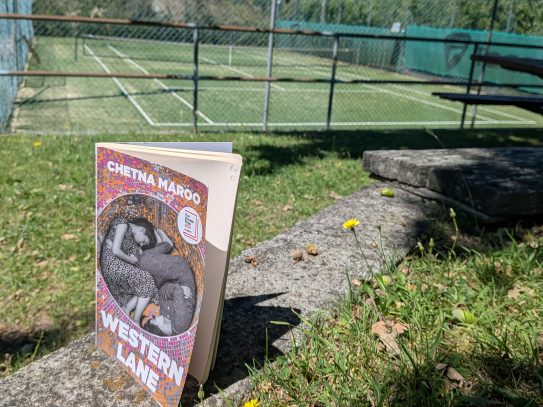
Western Lane suffers from the sports-induced simplification of life for which I critique my colleagues.
Western Lane is narrated by eleven year old Gopi, the youngest of three sisters, all of whom are wrapped up in grief after the recent death of their mother. There is little comfort provided by their father. In the first chapter an aunt suggests to the father that one of his daughters live with them to help relieve the burden of looking after the girls by himself. Is this a normal Indian thing to do, split a family up because there is no matriarch? It’s hardly endearing to the reader that the father actively considers this option in front of the girls… I am not rooting for a Little Miss Sunshine-esque dance scene at the end where the whole family learns to appreciate each other.
Instead of agreeing, though, the Dad tries to keep the girls. In an effort to both entertain and teach discipline he mandates daily squash lessons at the local facility named Western Lane. This develops into an obsession for Gopi and becomes her sole comfort in life. Squash is a safety for Gopi: it gives her a routine that helps her compartmentalise the loss of her mother, and it also helps her feel connected to her Dad. Literally everything Gopi and her Dad talk about and do relates back to squash. The prose is tender and spare, which makes me think Maroo is trying to depict this as a beautiful relationship, but to me it’s just empty and sad.
Maroo’s writing is lovely. She skilfully captures quiet domestic scenes of this broken family as though we readers are a well-behaved guest at the dining table, watching on.
But there’s too heavy a reliance on squash to drive the plot forward. There is no genuine tension. At one point there’s a complication where Gopi may not be able to attend an amateur squash tournament a few towns away. But it’s a hard sell to call that tension. Constantly setting the family drama in the context of squash (at the courts, watching it on television, discussion past famous players) eventually weighs down the book with repetition. For example, scenes at the squash court are well put together but not distinct enough to keep you engaged, which is particularly damning as the book is under 200 pages.
I like Maroo’s style. She is a calm and pleasing writer. I do really hope what she writes next is more exciting.
Western Lane has at its heart extremely relatable themes: family, grief and growing up. Maroo just got the balance wrong in this one. The universal stories were lost in the sport and the Indian-ness, distancing the reader and diminishing the charm of her writing.

Leave a Reply