
Recommend: Yes
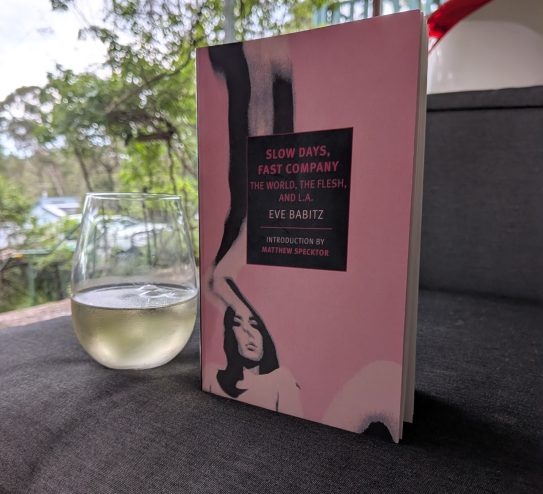
The full title of Eve Babitz’s 1977 collection of memoir-esque essays is Slow Days, Fast Company – the World, The Flesh and L.A. The subtitle is selling too hard. There’s not much of the World beyond L.A. depicted and the Flesh is alluded to regularly but does not itself make much of an appearance. That leaves L.A. and that is more than enough for this heady little novella-in-stories.
I was always destined to read Babitz. She sits as a contemporary to Joan Didion in time and geography. Both were writers and socialites in 1970s California. Both were, more than anything, cool. Part of that cool came from their listless nonchalance. Desires for pushing oneself were low; cares for the future could wait. Time pooled around the feet of these beautiful women.
There’s a lot to be said about the context in which you read classic literature. I read Slow Days, Fast Company over a stifling hot long weekend in Blackheath. I don’t think there’s any other way to do it. Babitz’s writing reflects off the sheen of perspiration slicking your arms and legs. Her yearning for rain a base desire remerging in yourself. The endlessness of Babitz’s California like the limbo of heat, reprieves from which are only found in condensation-dripping glass of white wine on a patio set in the afternoon.
It should be clear by now that there is no plot throughline in Slow Days, Fast Company. All reflections are through the hazy eyes of Babitz in her late twenties. Babitz spends time with lovers. She road trips to the outersuburbs of Los Angelese. She flits around in a threesome and then, searching for safety, falls into a long term relationship/sexual companionship with a well known gay. What holds the book together is Babitz’s enchanting writing around place.
I used to have an aversion to novels ‘about place’. If you’ve not been to the location in question, there’s such a hurdle to beginning these books. It feels as though you’ll be locked out of the entire ethos of the novel, being a stranger to its central premise. But, of course, conveying the unknown is exactly the miracle of excellent writing. The characters of Slow Days, Fast Company are more or less interchangeable. It is Los Angelese that shimmers through every chapter as the constant. Even when Babitz excursions outside of L.A., the absence of L.A., that great looming golden shadow in the rearview, weighs heavy.
Initially I wasn’t enjoying this book that much because there were a lot of references that either dated poorly or are niche American. After a few chapters though you learn to just filter that out and enjoy what is being offered to you. As you settle into the pace, there’s a reversal of age that takes place. You are transported to every Summer holiday you had in a place that was a bit too hot. It’s a languorous read that is endlessly quotable. There are brilliant little phrases scattered all throughout the book.
Ultimately, I was won over not by the charm of the characters but by the feeling of wandering day-in-day-out through urban sprawl, totally unimportant to the city, watched over with ambivalence by the surrounding hills.
If I ever visit America, I will be booking into Chateau Marmont. I hope to find someone there, reclining in the dining room, slowly picking at a plate of fries, and flicking coolly through Slow Days, Fast Company, dreaming of rain.


Leave a Reply