
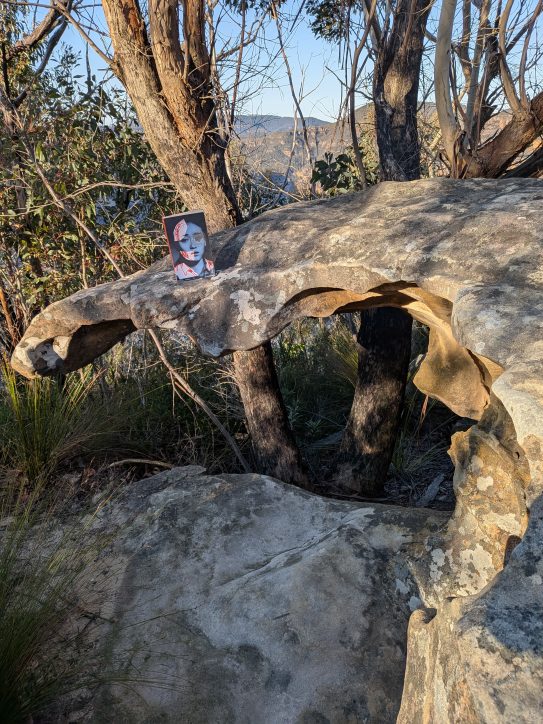
Recommend: No.
Too much focus is put on making memories in Modern Life.
Photographing meals preserves them forever more on Google Reviews but who wants to remember when there was not one but two long black hairs winding their way around my wrap from Manoush? Eating at Encore was meant to be a keystone meal but I could, without much hesitation, shelve the taste-memory of the vomit after eating too much fresh truffle hand-rolled pasta. Building a career in finance is glamourous when you’re knocking back free cocktails at Mr Wong’s but if we could all erase that time I yelled “unch” across the desk after the RBA did indeed actually hike rates, that would be grand. Or what about that time I cried in Hong Kong because our accommodation was a grim box? Bin that one too.
And, if it weren’t for this blog, I’d be content to let The Memory Police fade away in my mind, the details slowly leaking out over years, never to be revived.
Japanese literature seems to be split into to distinct quality grades.
There are the excitingly foreign authors that explore universal sentiments of discontent and alienation in a disconcerting Japanese culture (see: Izumi Suzuki, Yuko Tsushima). Reading these authors is a rush of blood to the head. The books are challenging and fast paced and harsh – and they are Westerner-friendly. They have narratives that mix unexpected suspense with unlikely sexual tensions and humorous sidekick characters, all caught within a tightly woven plots that keeps the pages moving.
And then there are the rest. The latest in this disappointing pile, tossed alongside Heaven by Mieko Kawakami, is The Memory Police.
Location: Japanese island.
Weather: Snow.
Plot set up: Items are being ‘forgotten’. The process of this forgetting is systematically enforced by the ‘memory police’.
Protagonist: bland.
Dialogue: bland.
Message: without context (the base of which is formed by memories), we unanchor and disappear. When discussion of history is censored in an authoritarian state, the promise of the future is dulled and focus turns to surviving the present. Bland.
There’s a structural issue with this book. When characters ‘forget’ something, they literally can’t describe the object. So the book is filled with these flimsy descriptions of the ‘vibe’ of mundane objects. At it’s most excruciating, books are banished from people’s memories and we have to spend the whole last quarter witnessing the protagonist desperately try to remember what a book is and how a story is told. As if the book-within-a-book trope wasn’t enough, the author (and/or protagonist) doesn’t even remember how to write it! At one point she just keys in gibberish (akin to asfafhurhewuirhfsdcj) to a typewriter. The Memory Police doesn’t always read that much differently to this fictional butchered manuscript…
The Memory Police’s plot is not intriguing to begin with – thought control implemented by an ambiguous evil entity, groundbreaking – and is very poorly fleshed out. What do the eponymous memory police want? How did they form? Why is their power uncontested? None of that, says Ogawa. That would be interesting. No, no. It would detract from the laboured descriptions of items that the characters don’t know how to describe. And perhaps there wouldn’t then be room to emphasise once again how hard it is to find strawberries in the shops, because apparently there’s also a food shortage on this island?
What an emotionless mess of ideas. What a disaster of repetitive scenes.
I picked up this book because it was foreign and had a cool cover. It’s not the first time I’ve made that misjudgment. It won’t be the last. But it can’t get worse, surely? Being in this book felt like being Bob and Charlotte in Lost in Translation: stuck in a wretched Japanese monotony that will eventually end, but not soon enough.
Bob: Can you keep a secret? I’m trying to organize a prison break. I’m looking for, like, an accomplice. We have to first get out of this bar, then the hotel, then the city, and then the country. Are you in or you out?
Charlotte: I’m in. I’ll go pack my stuff.
Bob: I hope that you’ve had enough to drink. It’s going to take courage.


Leave a Reply