
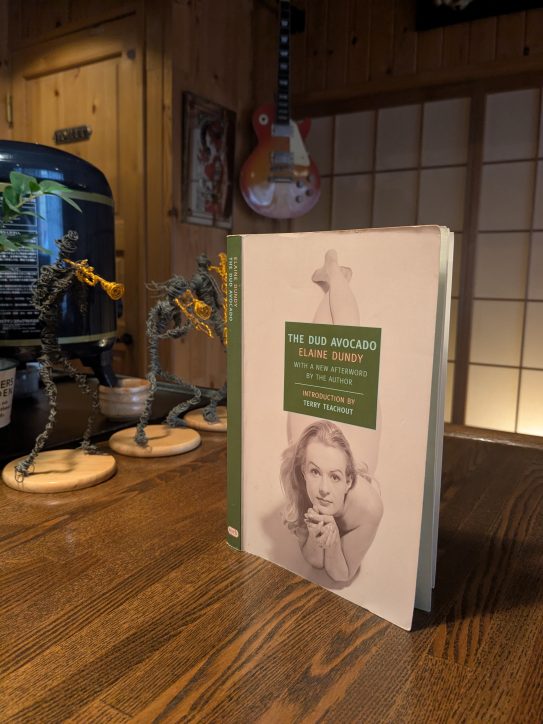
Recommend: Yes
Review is limited in nature due to being written while on holiday in Japan.
It’s a tale as old as time: girl is young but not too young; girl is ambitious but not overly talented; girl lives somewhere but wants to be somewhere else.
More specifically, in The Dud Avocado (published in 1958), the girl is Sally Jay Gorce. She is 21. She’s had some experience in acting but is no means a star. She’s from America and her eccentric uncle gives her some money to spend two years abroad now that she has finished college. Where else to go but the boulangerie lined streets of Paris?
The Dud Avocado doesn’t have a striking plot. We’re just following S.J.G. through her time in Paris. We hear about the bars she goes to and the streets she walks and, mostly, the people she meets. It’s a little bit Sex and the City: a narrator that has a constant voiceover for her life, with the supporting cast floating in and out the true entertainment.
I had fun with The Dud Avocado. S.J.G. prancing about Paris does get tiring after 250 pages – she’s more or else a spoilt child that has no job and little motivation yet expects the world – but the novel is written with enough skill that you never absolutely hate her.
There are some extended scenes that had me laughing out loud. In one, her socially daft but academically proud American cousin crashes a doomed dinner party. On one level, S.J.G. is humiliated by her wholesome but conversationally inept cousin, who cannot grasp the ridiculing banter of the Parisians at the table. At a deeper level, there is the fury he triggers in her by being in Paris – everything she was trying to leave behind in America resurfaces in his self-important, self-serious conversation attempts, and in front of her sophisticated Parisian ‘friends’.
The first thing that loomed into view, almost knocking Teddy down in his rush to get at me, was my loathsome cousin John Roger Gorce. John was a real, earnest, enthusiastic, gee-whiz tail-wagging prig of an American, with the shortest crew cut and the thickest horn rims ever to accompany their owner through four ceaseless interrogating of Harvard. Behind these spectacles blinked eyes that gawped and stared insensitively at anything not absolutely commonplace to the right side of the five-block area on which he had built his house in Wichita, Kansas.
He was blocking the passageway now, jamming us up against the door.
“Hee-Haw! Hee-Haw!” he bellowed suddenly into my face, his hands flapping by his ears, his nose twitching, his large teeth thrust forward in a really startingly successful donkey imitation. “Hee-Haw!”
Larry, caught off guard by this bizarre salute, cringed against the door. But I had been tensed for it. It had a very simple, very embarrassing explanation. It was the way John used to make me laugh when I was three and he was eight. Since then it had become his inevitable, unvarying greeting to me whenever I was unlucky enough to get within braying distance.
Because S.J.G. is not wholly likeable, when she fails there’s a bit of delight to be had at her expense. This vindictiveness between reader and narrator keeps the novel chugging along in the last third. Mostly.
The Dud Avocado does indeed have some blemishes.
The American Cousin Dinner Party Disaster I mentioned above was Dundy at her absolute finest. It was a top notch party chapter where the characters were interacting with each other hilariously rather than just trying to one-up each other, and S.J.G. was on equal footing to all other characters, knocked from her rickety high-horse, equally as horrid and horrified as the others.
Not all other party scenes have this narrative grace. In others, I found some of the conversations (which can be whole chapters) difficult to read as the characters parry, one shooting American colloquialisms and the other retorting with sentences entirely in French. There are also big chunks where the gang go from party to party without much really happening in the plot. There will be a few pithy one liners that are great but it feels like whole pages are written just for those small witty moments. S.J.G. herself comes across snide and lacking gusto, so when there’s a party scenes without any of the ‘good’ side characters I tended to glaze over, waiting patiently until the next advancement of plot or the reintroduction of the main cast.
Oh, and the ending is pure insanity. It is terrible. It centres around a character I don’t think we really meet until the last five pages. Unspeakably bad. Actually, so bad it almost made this book a ‘Not Recommend’. But by golly, in true S.J.G. fashion, she just scrapes by.


Leave a Reply